For South African litigation practices

Research you can put your name to.

MatterGraph finds the passages in South African judgments that bear on each point in your argument, shows you exactly where they sit in the judgment, and keeps a record of what you checked before you relied on it. When the authorities do not support a point, it says so. Nothing it produces enters your file until a lawyer has opened the source and signed it off.

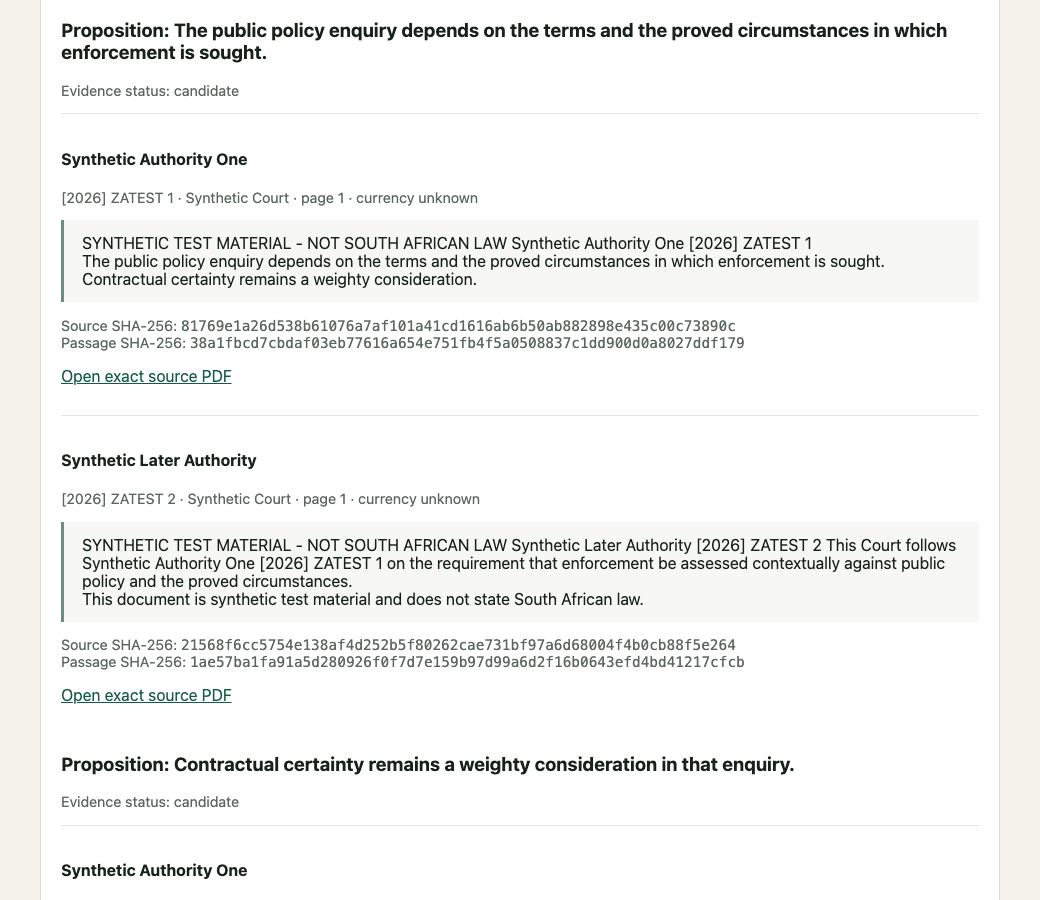
One point in a reviewed research map Synthetic test material
A proposition in the MatterGraph review workspace with two supporting passages. Each passage shows its citation, court, and page, the passage text quoted verbatim, and a link labelled open exact source PDF.
  1. 1The authority, its paragraph, and its page.
  2. 2The passage itself, word for word. Never a summary.
  3. 3One click opens the judgment at that page.
Captured from the running product on 2 September 2026 using synthetic test judgments. No real case is shown. Pilot corpora are built from judgments the courts publish.
Every point, with its passageEach proposition comes with the exact passage that supports it: judgment, paragraph number, page, and a link that opens the source at that page.
Silence where there is no supportIf the authorities you loaded do not support a point, it says so. If it cannot tell whether an authority is still good law, it says that too, and withholds any conclusion.
Your record, inside your firmOne deployment per firm, on hardware or a cloud account you control. What was reviewed and approved is written to a tamper-evident log. When an instruction ends, the deployment is deleted with a receipt.

01 · How a research task runs

Four steps, and a lawyer in every one that matters.

  1. 1

    Frame the question

    State the legal question and the points you need to make. Choose which authorities the task may draw on: the court-published judgments loaded for that matter, and nothing else.

  2. 2

    Get candidate passages

    For each point, MatterGraph retrieves the closest passages from those judgments, ranked, each with its paragraph and page. It does not rewrite or paraphrase them.

  3. 3

    Open the source and decide

    In the review workspace you open each cited judgment at the cited page, then accept the passage, reject it, or send corrections. Nothing is approved from a chat window.

  4. 4

    Keep the trail

    The reviewed map is frozen with a fingerprint and your approval is attached to it. Change one character and the approval no longer applies. You can show a colleague, a client, or a court exactly what was checked and when.

02 · When there is no support

It tells you what it could not establish.

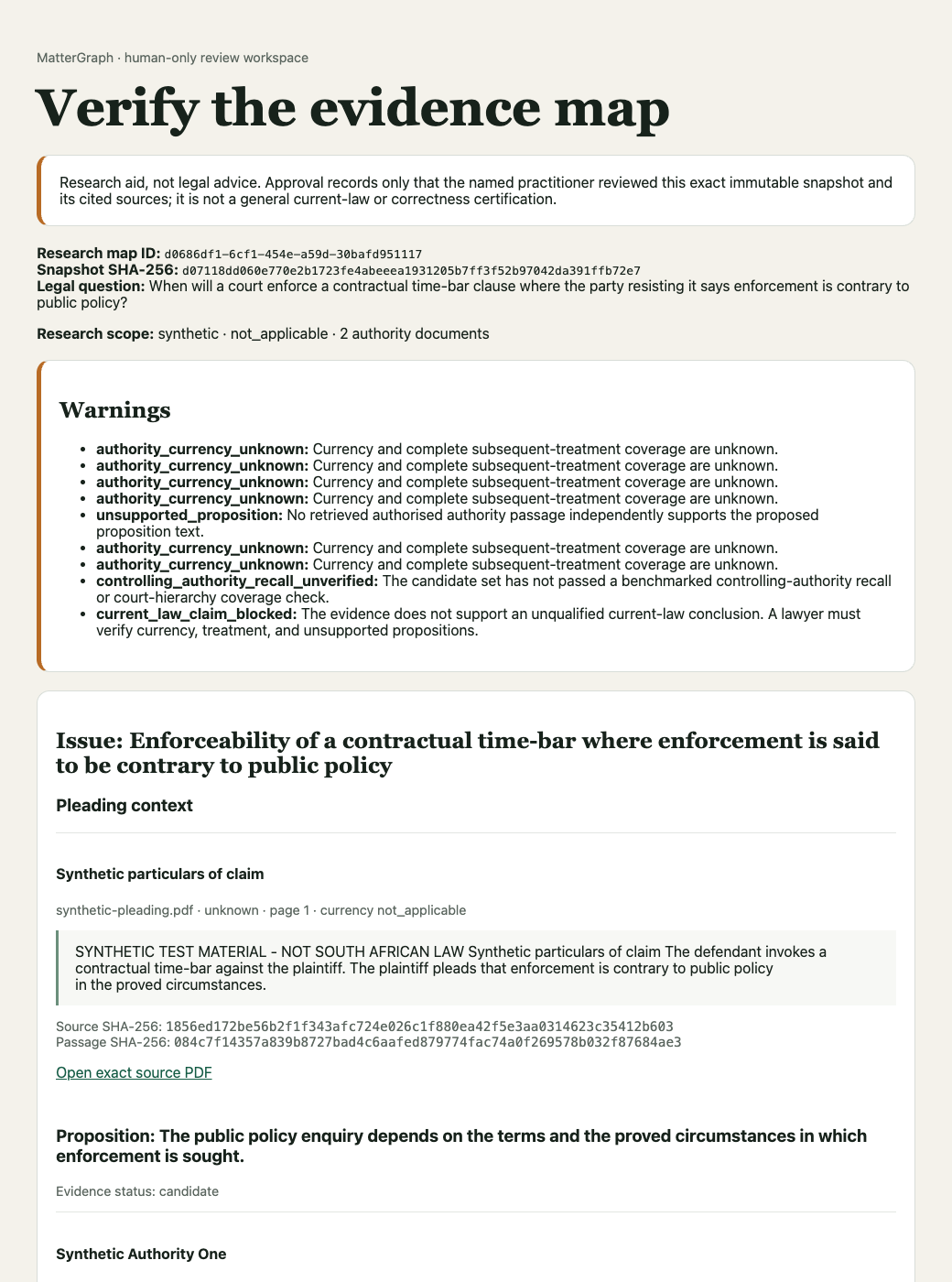
A research map carries its warnings on its face. A point with no supporting passage is marked unsupported. An authority whose status is unknown is marked as such. Until those are cleared by a lawyer, the map states that no conclusion about the current law is offered.

  1. 1Every warning, by name, before the evidence.
  2. 2The conclusion is withheld, not softened.
The top of a review packet Synthetic test material
The top of the MatterGraph review workspace: a boundary notice reading research aid, not legal advice; the research map identifier and fingerprint; the legal question; and a warnings box listing unsupported proposition, authority currency unknown, and current-law claim blocked.

03 · What you can rely on

What it will not do, so that you can trust what it does.

These are limits built into the software and tested, not lines in a disclaimer.

  • It will not tell you what the law is today. Until a benchmark marked by your own lawyers shows that it finds the controlling authorities for a practice area, every result carries that caveat and no conclusion about current law is offered.
  • It will not touch your confidential files in the pilot until four things are signed. An operator agreement under POPIA, an approved model provider that retains none of your content, an authorised document pack with its rights record, and a lawyer-marked evaluation. The software refuses to declare itself ready without all four.
  • It will not scrape. Authorities come from what the courts publish themselves. Each judgment in a pack is checked against the court's own file before it is used.
  • It will not act for you. There is no agent that drafts to a client or files anything. This is research, evidence, and review, with a lawyer's decision at the end.
  • It will not quietly keep your data. Deleting a matter physically removes it and issues a receipt. Ending an engagement removes the whole deployment.

04 · Where your information goes

Inside your firm, unless you approve otherwise.

The boundary is your own deployment, not a row in a shared database. What crosses it is narrow, approved in writing, and logged.

Stays inside

The judgments, the research maps, the approvals, the log

All of it lives in your deployment's own database and keeps working with the network cable pulled.

Compute you control

Reading and indexing documents

Runs on your hardware, or on a machine inside your own cloud account that keeps nothing afterwards.

Leaves only with approval

Selected passages to an approved model

Only the specific passages retrieved for a question are sent to a model, and only to a provider your firm has approved in writing with no retention of your content. Whether that provider may process outside South Africa is your information officer's decision, recorded, never a default.

05 · The design-partner pilot

One practice group. One recurring task. Your own benchmark.

We are inviting a small number of litigation practices to shape MatterGraph before it is offered generally. Enquiries and preliminary onboarding run in the last quarter of 2026. The pilot itself runs in the first quarter of 2027.

What we ask of you

  • One practice group and one research task you do often enough to care about.
  • The court-published judgments that task should draw on. We verify each against the court's own file.
  • One lawyer willing to spend a few hours marking which passages actually support which points, and to review results against the sources.
  • Candid feedback, including where it got in the way.

What you get

  • A deployment inside your own boundary, set up with you.
  • The operator agreement, the threat model, and the deletion procedure to read before you decide anything.
  • The results of your own benchmark: how often the citations were right, how often the passages supported the point, and what was withheld.
  • A direct say in what is built next.

What the pilot build must pass before we call it grounded

Passing these is not a claim of legal correctness. A South African lawyer marks the benchmark and stays responsible for the legal work.

CheckRequiredMeasured against your lawyer's marking
Citations are correctAt least 95%The judgment, its citation, court, and date match the authority your lawyer marked
Passages support the pointAt least 90%The cited passage is one your lawyer accepted for that point
Nothing in your benchmark is left out100%Every issue and point you marked appears in the map
No conclusion presented as settledAlwaysNo map offers a current-law conclusion while any evidence is missing
The record reproducesAlwaysRecomputing the fingerprint over the stored map gives the same value
Controlling authorities foundReported to youBecomes a pass/fail check only when you set the target

06 · Who we are

Who you would be talking to.

Tim Lai · Founder

Platform engineer, Johannesburg. Through ReactorJet, Tim builds cloud systems where scale matters and local systems where confidentiality has to be enforced by the architecture rather than promised in a policy. MatterGraph applies that discipline to what South African privacy and professional-conduct rules ask of legal AI, an area with no technical standard yet, by making evidence, review, and deletion mechanical and holding the implementation to the strictest reading of the law.

SA Legal Intelligence

A trading name of the founder, 35 1st Avenue, Illovo, Sandton, 2196, with salegalintelligence Pty Ltd being incorporated to carry the business. MatterGraph is the product. The core is our own; the open-source components it runs beside are listed in the deployment notes every design partner receives.

How we work

Product decisions, including what the software refuses to do, are written down with their reasoning and shared with design partners. If one changes, you see the change and the date.

07 · Start a conversation

Tell us the research task you would most like to trust.

The first conversation is to work out whether there is a bounded pilot worth running, and to give you the operator agreement, the handoff kit, and the threat model to read before you decide.

A named person replies within two working days. No newsletter, no sequence.

We keep your firm, name, work email, and what you write here, to reply and to prepare for one conversation. Not shared, not used for marketing, deleted within 90 days if no conversation follows. Full notice: privacy.

Professional context. The Legal Practice Council's practical vocational training guide on information and communication technology for practice (issued under Regulation 6(10)(n), March 2026) tells candidate attorneys that "AI and AI tools are having a disruptive effect on the legal profession" and that they are expected to use AI in the interests of the client and the firm. On research it is direct: a lawyer must still apply their mind to the facts and the law and reach a reasoned solution, and "the current AI models cannot do that." It records two 2025 judgments in which cited cases did not exist and the practitioners were held negligent, and it instructs that a citation which cannot be found in the usual places is a hallucination and must not be used. MatterGraph is built for exactly that duty: nothing it shows is more than a passage you can open and check.